What is GEO (generative engine optimization)?
Updated
GEO, or generative engine optimization, is the work of getting your business named in the answers ChatGPT and other AI assistants give when customers ask for a recommendation. Where SEO ranks your pages in a list of links, GEO aims for the answer itself: the few businesses an AI assistant names.
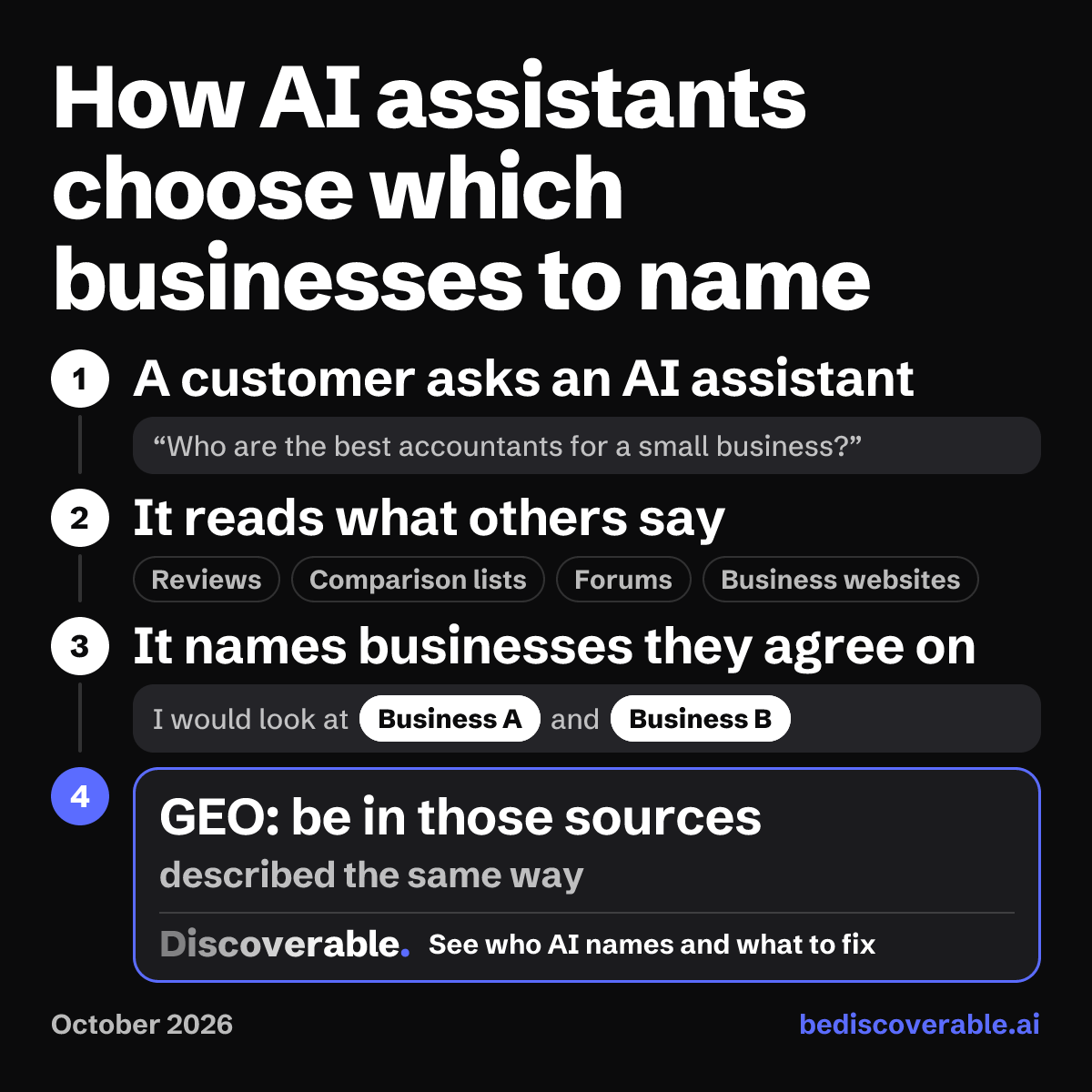
The work starts with finding out whether AI names you today. Most of the rest happens on other websites: the review sites, comparison lists, directories and forums an assistant reads before it answers. Your own website still counts, as the place an assistant checks what you sell, where and for how much.
How GEO works
A customer asks an AI assistant a question about what you sell, such as "Who are the best accountants for a small business?"
It reads what others say: reviews, comparison lists, forums and business websites. Some answers come from a live web search, others from what the assistant learned in training.
It names businesses they agree on. A business that several independent sources name, and describe the same way, is the likely answer; one that is missing from them, or described differently on each, is easy to leave out. More on how ChatGPT decides which businesses to recommend.
GEO: be in those sources, described the same way. Find out which businesses AI names for your customers' questions, then work on the sources it reads and on your own website.
GEO compared with SEO
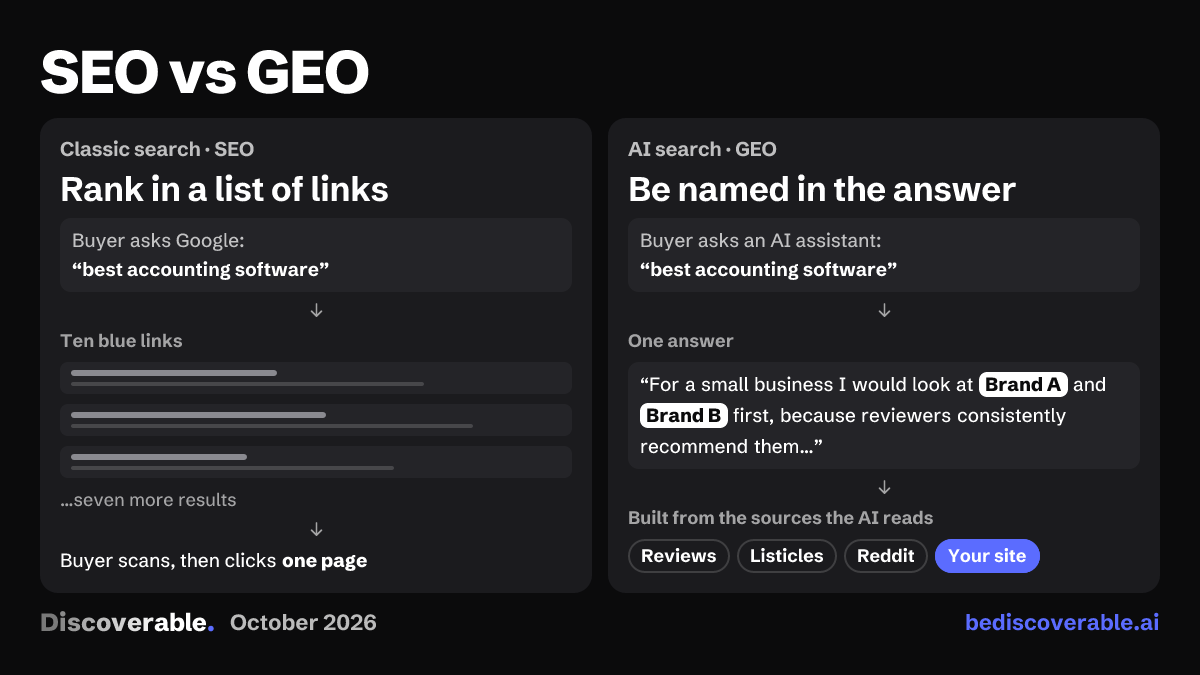
SEO gets your pages ranked in a list of search results; GEO gets your business named inside the answer. The groundwork is shared: Google says the best practices for SEO remain relevant to its AI Overviews and AI Mode, and an assistant can only quote a page it can reach. GEO then puts more of the work into what other websites say about you. GEO vs SEO sets the two side by side.
Is AI SEO the same as GEO?
Yes, in everyday use. AI SEO, AI search optimisation, LLM SEO and AEO are other names for getting your business named in AI answers, and the work behind them is the same. GEO is the name a 2023 research paper gave it, GEO: Generative Engine Optimization, which describes AI search tools that answer by summarising several sources. One phrase means something else: "AI SEO tools" is often software that uses AI to do ordinary SEO work, such as writing pages or researching keywords. How the names differ is in AEO vs GEO vs SEO.
What GEO means for a small business
When a customer asks an AI assistant who to use, the answer names a few businesses. Being one of them puts you on the customer's short list; missing from it, you may not be considered at all. For a small business most of the work is familiar: ask happy customers for reviews on the sites your customers read, get onto the directories and comparison lists that already rank for what you sell, describe your business the same way everywhere, and say plainly on your website what you do and where.
Questions about GEO
How can I tell if AI recommends my business?
Ask an AI assistant the questions your customers ask, in their words, and note whether your business is named, how early in the answer, and which websites it cites. Ask more than once: the same question can get a different answer each time. The free AI visibility checker needs no login and runs on Claude, ChatGPT and Google AI Overviews. To see ChatGPT's own answers, check if your business is on ChatGPT. Paid plans check your 10 tracked prompts on every AI service each week.
How long does GEO take to work?
It depends on where the answer comes from. When an assistant searches the web before it answers, a change to the pages it reads can show up once those pages are crawled again. When it answers from memory, the change waits for a newer model trained on newer pages, which can take months. One check proves little either way, so ask the same questions every week and watch the trend.
Do I need an agency for GEO?
No. Most GEO work is what a business owner already does: asking customers for reviews and keeping your listings and website up to date. An agency can save you time on outreach to the sites that publish comparison lists. If you hire one, ask which AI answers it measured before and after the work. Discoverable's own generative engine optimization services are priced on request.
Do I need special code or an llms.txt file?
Not for Google. Google says AI text files such as llms.txt neither harm nor help your visibility in its search, and that its AI features need no special schema.org markup. What does matter is being reachable: Google only links a page from AI Overviews and AI Mode if it is indexed and eligible for a snippet, and OpenAI says sites that opt out of its search crawler, OAI-SearchBot, are not shown in ChatGPT search answers.